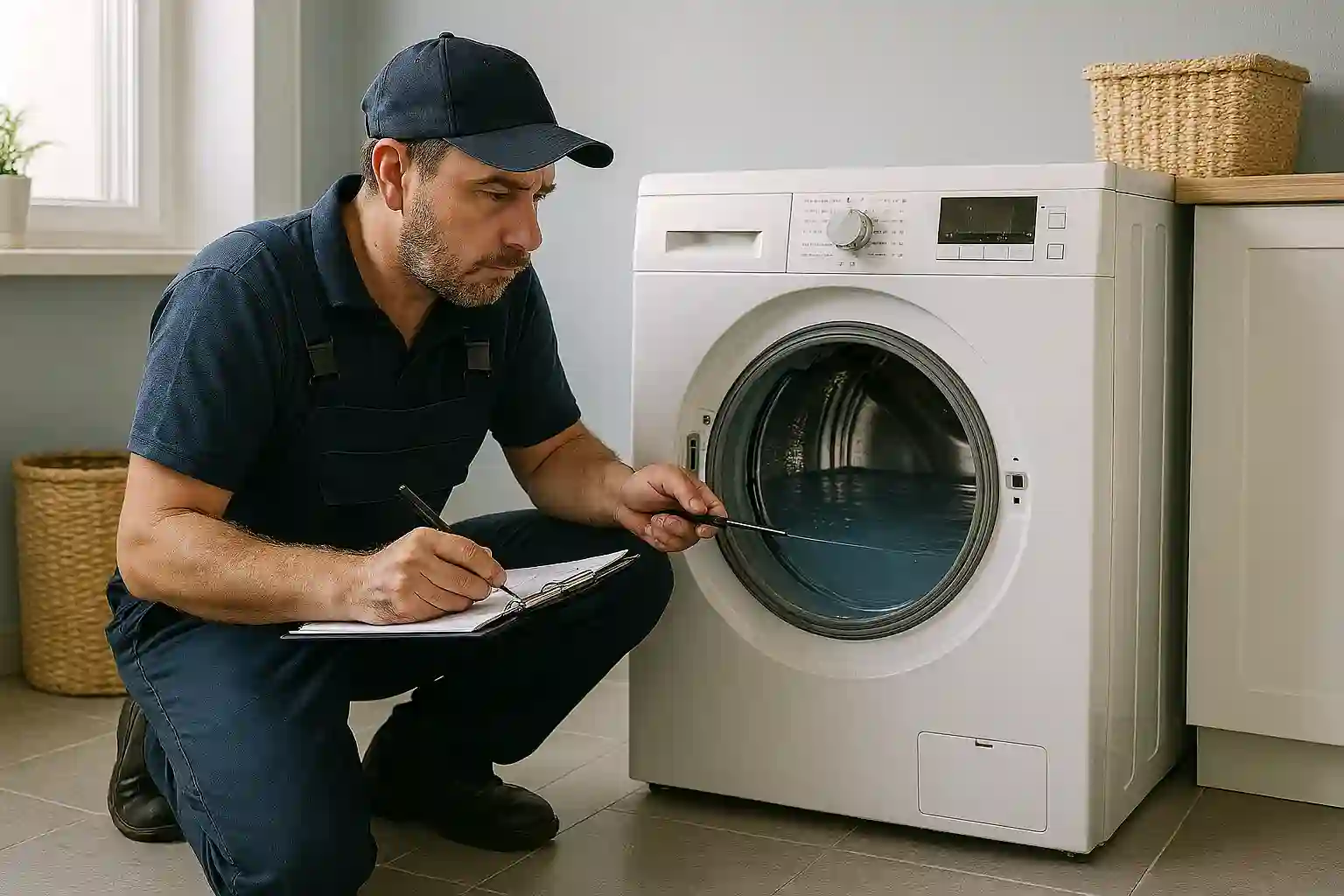

If your washing machine finishes a cycle and leaves your clothes sitting in water, the problem is usually one of a few common faults: a blocked drain hose, a clogged pump filter, a jammed or failed drain pump, a lid or door lock issue, an overloaded or unbalanced load, excessive detergent suds, or incorrect drain hose installation. These are among the most common drainage issues highlighted by major manufacturers and appliance repair guidance.
For households across Sydney’s North Shore, a washer that will not drain is more than an inconvenience. It interrupts the whole laundry routine and can lead to leaks, odours, or unnecessary wear if the machine keeps trying to run with standing water. AI Appliance Services already offers washing machine repair across Sydney’s North Shore and North Sydney, so this topic fits naturally with the services already visible on the site.
In this guide, we will walk through the seven most common reasons your washing machine is not draining, what you can safely check yourself, and when it is time to call a technician.
1. The drain hose is kinked, blocked, or installed incorrectly
If the appliance is still in generally good condition and the fault appears limited to one area, repA kinked or blocked drain hose is one of the most common reasons a washing machine cannot drain properly. Manufacturers also warn that incorrect hose positioning or installation can cause water flow problems or siphoning, where water moves back into the machine instead of draining away properly.
What to check
- Pull the machine forward carefully and inspect the hose at the back.
- Look for bends, crushing, or obvious blockages.
- Make sure the hose has not slipped too far into the standpipe or become sealed too tightly, as some brands note that this can interfere with draining.
What to do next
If the hose is visibly kinked, straighten it and test the washer again. If it looks blocked, do not force tools through the hose unless your model documentation allows it. If you are unsure, it is better to book a repair before a small blockage turns into a pump failure.
2. The pump filter is clogged
Many front-load washing machines have a pump filter designed to catch lint, coins, hairpins, and other debris before it reaches the drain pump. If this filter becomes clogged, water cannot leave the drum efficiently. Whirlpool, Samsung, and appliance repair guidance all point to the drain pump filter as a common cause of drainage issues.
What to check
- Look for a small access panel near the bottom front of the washer.
- Turn the machine off first.
- Keep towels and a shallow tray ready, because water may spill out when the filter is opened. Samsung notes that if the washer has recently run a hot cycle, water inside may still be very hot.
What to do next
If your washer has an accessible filter, clean out lint and trapped debris, then re-fit it securely. Always check your owner’s manual for your model-specific method because not all machines use the same access design.
3. The drain pump is jammed or failing
There are times when replacement is the smarter choice. CHOICE warns that when an If the filter is clear and the hose is fine, the next likely culprit is the drain pump itself. A pump can be blocked by a small item such as a sock, coin, or hair clip, or it may fail mechanically or electrically. Repair guidance commonly identifies the drain pump as a key reason a washer will not empty.
Common signs of a pump problem
- The machine hums but no water drains
- You hear grinding or unusual noises
- The cycle ends with water still inside
- The washer repeatedly stops before spin or drain completes
What to do next
This is usually the point where professional diagnosis makes sense. Reaching the pump often involves removing panels and working around electrical components and water lines. If the pump is jammed, cleaning it may solve the issue. If it has failed, replacement is usually required.
4. The door lock or lid switch is not engaging
Many machines will not drain or spin unless the washer detects that the door or lid is closed securely. Whirlpool and other repair references note that a faulty lid switch on top-load machines or a door-lock issue on front-load models can stop the drain cycle entirely.
What to check
- Make sure the door closes fully with no trapped clothing.
- For top-loaders, check whether the lid closes firmly and normally.
- If the washer shows a door or lock error, do not keep forcing new cycles.
What to do next
If the machine still refuses to drain even though the door appears shut, the latch or switch may need testing or replacement. This is not usually a DIY job for most homeowners.
5. The load is unbalanced or the washer is overloaded
Many homeowners assume that once the manufacturer warranty has ended, all responsibility ends too. That is not necessarily true. The ACCC states that consumer An overloaded or unbalanced load can stop the washer from spinning and draining properly. Whirlpool notes that heavy or uneven loads may cause the machine to pause or reduce spin effectiveness, leaving clothes much wetter than expected.
What to check
- Open the machine and see whether towels, bedding, or bulky garments are tangled on one side.
- Remove a few items if the drum looks packed too tightly.
- Re-run a spin or drain cycle after redistributing the load.
What to do next
If the washer drains properly after balancing the load, the issue may not be mechanical at all. It may simply be a loading habit that needs adjusting.
6. Too much detergent is creating excessive suds
Excessive detergent, especially the wrong formula for the machine, can create too many suds. Whirlpool warns that too many suds can interfere with pumping and spinning, leaving the load wet or the machine unable to complete the drain cycle correctly.
What to check
- Look for visible foam inside the drum.
- Think about whether more detergent than usual was used.
- Confirm you are using the correct detergent type for your machine, especially with high-efficiency models.
What to do next
Run a rinse and spin cycle with no extra detergent. If suds were the cause, the washer may clear itself after one or two rinse cycles. If not, there may still be a drainage fault elsewhere.
7. The machine needs a reset or has a control fault
Sometimes the issue is not a blocked part but an interrupted cycle or control glitch. Appliance repair guidance often recommends starting with a simple power reset before assuming there is a major mechanical problem.
What to do next
- Turn the washer off.
- Unplug it briefly.
- Plug it back in and try a drain or spin cycle again.
If the machine still will not drain after basic checks and a reset, there is a good chance the fault is with the pump, latch system, drain path, or control components.
What you can safely do before calling a technician
If your washing machine is not draining, these are the safest first checks for most homeowners:
- Turn the washer off and unplug it before inspecting anything.
- Check whether the load is overloaded or unbalanced.
- Inspect the drain hose for kinks or obvious crushing.
- Clean the accessible pump filter if your model has one.
- Re-run a drain or spin cycle after a simple reset.
If the washer still holds water, makes unusual noises, leaks, or repeatedly stops mid-cycle, it is time for professional repair.
When to book a washing machine repair
You should stop troubleshooting and call a technician if:
- water remains in the drum after basic checks
- the washer is leaking onto the floor
- you hear grinding, buzzing, or repeated clicking
- the door stays locked or the machine shows a drain error
- the problem keeps coming back after cleaning the filter or adjusting the hose
For local homeowners, AI Appliance Services already positions washing machine repairs as one of its core services across Sydney’s North Shore and North Sydney.
Key takeaways
- A washing machine that will not drain is commonly caused by a blocked hose, clogged filter, pump issue, door or lid fault, unbalanced load, excess suds, or a control reset problem.
- Start with the simple checks first: power reset, load balance, drain hose, and accessible filter.
- If water remains in the machine after those checks, the problem may need professional diagnosis.
- Acting early can help prevent water damage, bad odours, and more expensive repairs.
FAQ
Conclusion
A washing machine that is not draining does not always mean a major repair, but it does need attention quickly. In many cases, the issue is something simple like a clogged filter, a kinked hose, or an overloaded drum. In others, it points to a failing pump, a faulty switch, or a drainage setup issue that needs proper diagnosis. Either way, the sooner you identify the cause, the easier it is to prevent a bigger repair later.